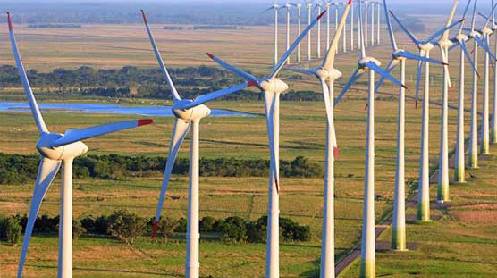
HAMBURG/BERLIN/LONDON: Britain, Germany, Denmark and several other European nations have reinforced their commitment to clean energy by signing a pact to jointly develop 100 gigawatts (GW) of offshore wind power capacity, marking a major step toward strengthening Europe’s energy security.
The agreement was signed at a summit in Hamburg and underscores Western and Northern Europe’s continued backing of wind energy, in sharp contrast to US President Donald Trump’s criticism of green energy policies. Speaking at the World Economic Forum in Davos last week, Trump reiterated his opposition to wind power, claiming countries relying on turbines lose money.
Britain’s Energy Minister Ed Miliband said the initiative served national interests by reducing reliance on fossil fuels. “Driving clean energy can take the UK off the fossil fuel rollercoaster and deliver energy sovereignty and abundance,” he said, adding that ending dependence on Russian energy remained a top European priority.
On Monday, European Union member states also gave final approval to a legally binding ban on Russian gas imports by late 2027, nearly four years after Russia’s full-scale invasion of Ukraine. However, analysts warn of a new dependency emerging, as the EU sourced 27 per cent of its gas and LNG imports from the United States in 2025 — a figure that could rise to 40 per cent by 2030 under new contracts, according to the Institute for Energy Economics and Financial Analysis.
The new offshore wind pledge builds on a broader commitment made by North Sea countries in 2023 to develop 300 GW of offshore wind capacity by 2050. Industry body WindEurope said its members have also committed to cutting costs, creating around 91,000 jobs and generating up to €1 trillion ($1.2 trillion) in economic activity.
Adding 100 GW of offshore wind would significantly reshape Europe’s power market. The region currently has 258 GW of installed wind capacity, both onshore and offshore, accounting for about 19 per cent of Europe’s electricity supply, according to WindEurope.
The expansion is expected to benefit grid technology providers such as Siemens Energy and GE Vernova, developers including RWE and Ørsted, and turbine manufacturers such as Vestas. Grid operators National Grid and Germany’s TenneT also announced plans to jointly develop a power link connecting British and German offshore wind farms in the North Sea, enabling electricity to be shared between the two countries.
By Reuters